
Did someone hit you as you were riding your motorcycle in Atlanta? That person could owe you money for your medical bills, lost income, and pain and suffering, but their insurance provider would rather keep their profits than pay you fairly.
That’s why you need an experienced Atlanta motorcycle accident lawyer to guide you through the claims process and fight hard for fair compensation.
Our team has over five decades of combined legal experience and a record of over $2 billion recovered for accident victims. Firm founders Frank Bayuk and Bradley Pratt’s experience as senior partners for some of the country’s top defense law firms showed them firsthand how insurers fight accident claims.
Now, they use their knowledge and insight to craft winning strategies for motorcycle accident victims in Atlanta – and they’re ready to start work on your case today.
Don’t wait another moment to demand what you’re owed. Contact Bayuk Law for a free, no-obligation consultation and case review. An Atlanta motorcycle accident attorney from our firm will discuss your legal options for recovering compensation.

How Common Are Motorcycle Accidents in Atlanta?
Motorcycle accidents are common in Atlanta, and motorcycles are significantly overrepresented in crashes involving injuries and fatalities.
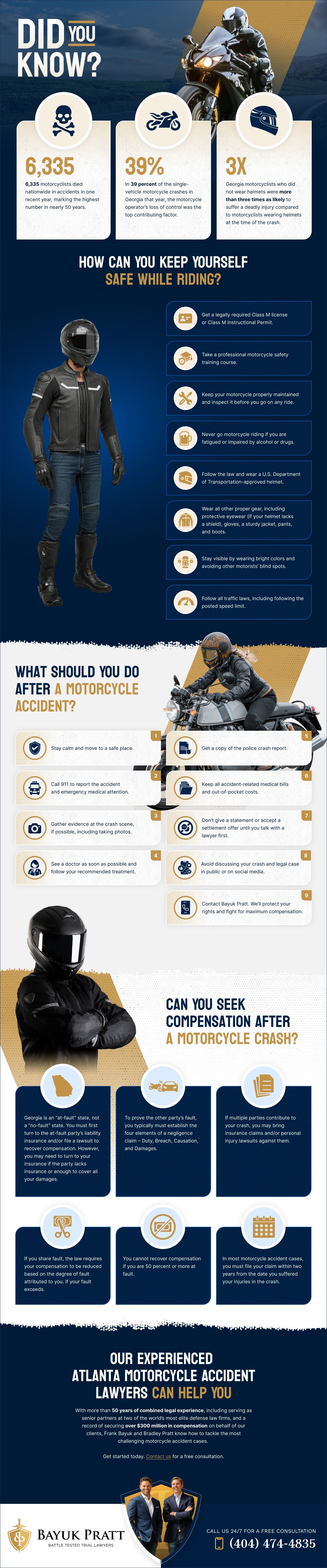
According to data from the Georgia Department of Driver Services, motorcyclists account for only about 2 percent of registered vehicles. However, motorcycle riders account for nearly a tenth of traffic fatalities.
Per mile travelled, motorcyclists are nearly 28 times more likely than occupants of passenger vehicles to die in a motor vehicle crash and five times more likely to be injured. Over 40 percent of all motorcycle crashes in Georgia occur in or around the Atlanta metro area, most likely due to the area’s high traffic volume and extensive highways.
Does Wearing a Helmet Make a Difference if You Are in a Motorcycle Crash?
Yes, wearing a helmet can affect the outcome of a motorcycle accident in Georgia. Motorcycle helmets significantly reduce the incidence of head injuries in a collision.
Georgia has universal motorcycle helmet laws requiring all motorcycle drivers and riders to wear head protection, regardless of age or riding experience.
If you get into an accident without a helmet and sustain head or neck injuries, you might be judged partially at fault. Under Georgia’s comparative negligence laws, shared fault can reduce the amount you receive in any settlement or jury verdict.
Whether or not a helmet would have prevented an injury depends on the type of injury. If wearing a helmet would have reduced injury severity, such as with traumatic brain injuries, it’s more likely insurers will try to hold you at least partly at fault.
You may still be able to recover compensation for injuries not affected by wearing a helmet. Wearing a helmet while on your motorcycle can reduce the risk of serious injury and preserve your ability to recover the maximum compensation after a motorcycle accident.
An experienced motorcycle crash lawyer can review the specific details of your accident and discuss your right to pursue a motorcycle accident claim.
What Are the Motorcycle Laws for Atlanta and Georgia?
Knowing Georgia’s motorcycle laws matters because noncompliance can impact your ability to recover financial damages after a motorcycle wreck. If you violate Georgia motorcycle laws and get into a collision, your non-compliance with the law could make you ineligible to pursue a personal injury claim for your losses.
There are several essential motorcycle laws you should know and follow to protect yourself from accident liability:
- License Requirements – You must have a Class M motorcycle license or permit to operate a motorcycle in Georgia legally. Riding without a valid license is a misdemeanor and can result in a fine of up to $1,000.
- Helmet Laws – OCGA 40-6-315 states that all riders and passengers on a motorcycle must wear a DOT-approved helmet. All riders must wear eye protection or have a windshield on their bikes. Violating helmet laws is a misdemeanor punishable by a fine of up to $1,000.
- Motorcycle Insurance Requirements – All riders in Georgia must carry at least $10,000 in property damage liability coverage, $15,000 in injury liability coverage per person, and $30,000 in injury liability coverage per accident.
- Lane Splitting – Lane splitting, or riding between lanes of slow or stationary traffic, is illegal in Georgia, per OCGA 40-6-312. The penalty for lane splitting is a fine and three points on your license. However, two motorcycles can ride side by side in a single lane.
- Traffic Laws – Motorcyclists are subject to the same traffic rules as other drivers. They must obey traffic signals, follow the speed limit, signal before turns, and yield the right-of-way when required.
- Equipment Laws – To be street legal, a motorcycle must be equipped with a side mirror, handlebars that are less than 15 inches above the seat, and working headlights and taillights.
Benefits of Hiring an Atlanta Attorney for Your Motorcycle Accident Claim
By hiring a motorcycle accident lawyer in Atlanta from Bayuk Pratt, you’ll have the freedom to focus on your injury treatment and rehabilitation while we work on your claim.
Our motorcycle accident lawyers will:
- Investigate the crash to secure evidence
- Identify liable parties and avenues for compensation
- Negotiate for a fair out-of-court settlement
- Take your case to trial if the insurer won’t play fair
What to Do After a Motorcycle Accident
Following an accident on your motorcycle resulting from someone else’s negligence, you can put yourself in a favorable position to seek financial recovery and justice for your injuries by:
- Reporting the accident to law enforcement and requesting a copy of the police crash report
- Notifying your motorcycle insurance provider about the accident
- Seeking prompt medical attention and following your doctor’s treatment plan
- Obtaining copies of the medical records of your treatment and rehabilitation
- Gathering copies of pay stubs or income statements if you miss time from work or earn less than before the crash
- Keeping all bills, invoices, and receipts of your expenses
Finally, remember to contact an Atlanta motorcycle wreck attorney from Bayuk Pratt as soon as possible to start pursuing the financial resources you need to put your life back on track.
How We Investigate Atlanta Motorcycle Accident Cases
At Bayuk Pratt, our legal team thoroughly investigates motorcycle accidents to recover all available evidence. Having a complete picture of a crash allows us to identify all at-fault parties and evaluate our clients’ legal options for financial compensation.
Some examples of evidence we use in investigating motorcycle crashes include:
- Police accident reports
- Accident scene photos or videos
- Surveillance and traffic camera footage
- Dashcam and helmet cam footage
- Eyewitness testimony
- The driver’s cell phone records
- The driver’s post-crash alcohol and drug test results
- Vehicle computer data logs
- Repair and maintenance records
- Post-accident vehicle inspections
- Accident reconstruction expert reports and testimony
Compensation You Could Recover in an Atlanta Motorcycle Accident Claim
You may have a claim to obtain financial recovery for expenses or losses you incur due to injuries suffered in a motorcycle collision.
Your motorcycle accident compensation can provide you with money for your:
- Repair or replacement costs for other damaged property, such as your motorcycle helmet
- Medical treatment and rehabilitation expenses
- Costs of long-term disability care and support services, such as housekeeping
- Lost wages or income
- Loss of future earning capacity and job benefits if you suffer permanent disability
- Physical pain and anguish
- Emotional trauma and distress, including reduced quality of life caused by disabilities or permanent disfigurement from your injuries
- Motorcycle repair expenses or reimbursement for the value of your bike if the accident totaled it
How a Motorcycle Accident Differs from a Car Accident
Injured motorcycle riders face certain challenges in pursuing financial compensation that victims of other motor vehicle accidents do not.
Some of the factors that can make motorcycle accident claims different from car accident claims include:
- More Severe Injuries – Because motorcycle riders typically suffer severe injuries in a crash, motorcycle accident claims can involve substantial amounts of compensation that may make insurance companies fight harder to minimize their financial liability.
- At-Fault Drivers May Lack Sufficient Insurance – Some drivers purchase the minimum liability insurance required by law. However, these basic policies frequently do not provide full compensation to injured riders, which may require them to turn to other sources of financial relief.
- Anti-Motorcyclist Bias – Drivers may rely on popular stereotypes of motorcycle riders as “outlaws” to claim that a rider did something careless or reckless that caused the accident. When a driver tries to shift blame for a crash to the rider, the rider may need additional evidence to prove that the driver caused the accident.
What Happens If Someone Dies as a Result of an Atlanta Motorcycle Accident?
Motorcycles have a significantly higher fatality rate in accidents than passenger cars. Many motorcycle claims involve wrongful deaths. When someone dies in a motorcycle accident due to negligence or wrongdoing, their spouse or children may have the right to file a wrongful death lawsuit (OCGA 51-4-2).
Through a wrongful death lawsuit, they can recover the “full value of the life of the decedent,” which includes economic and non-economic losses, such as medical bills, lost wages, and pain and suffering. Any proceeds from a wrongful death lawsuit are split equally between the surviving spouse and any children.
If the deceased has no spouse or children, then their parents can file a wrongful death lawsuit. Suppose the motorcycle accident victim has no surviving spouse, children, or parents. In that case, the deceased’s personal representative can bring a wrongful death lawsuit and hold the proceeds for the deceased’s next of kin.
What If the Driver Who Hit Me Has No Insurance?
Georgia requires every driver to carry liability insurance, but some people ignore the law and drive uninsured. Other motorists carry only the minimum coverage, which often falls short of covering the medical expenses and lost income a motorcycle crash can cause.
Your own uninsured motorist or underinsured motorist insurance policy may offer a path forward.
Under O.C.G.A. § 33-7-11, Georgia insurers must include uninsured motorist (UM) coverage in every motor vehicle liability policy they issue unless the policyholder rejects the coverage in writing. UM coverage can pay for your injuries when the at-fault driver has no insurance, carries too little insurance, or flees the accident scene without being identified. Depending on the terms of your policy, your UM benefits may pay in addition to the at-fault driver’s coverage.
You will need to file a claim against your own insurance to access uninsured motorist coverage. Your insurance company may look for reasons to dispute or deny your UM claim. You may need legal support. An Atlanta motorcycle accident attorney with Bayuk Pratt can review every policy that might apply (including coverage on other vehicles in your household). We will push your insurer to honor its promises.
Can You Sue for a Motorcycle Accident Caused by a Dangerous Road?
Road hazards pose a far greater threat to motorcyclists than to people in cars and trucks. A pothole that jolts a sedan can throw a motorcycle rider onto the pavement and cause severe injuries. Some common hazards include:
- Potholes and broken pavement
- Loose gravel or debris
- Uneven lanes or steep pavement shoulders left by road work
- Missing or damaged warning signs
- Poor drainage that leaves standing water
When a hazard like this causes a crash, you may have a motorcycle accident claim against whoever had responsibility for maintaining or constructing the road. That could include a construction company that failed to post warning signs or a contractor that left steep shoulders. In many cases, the responsible party is a government agency.
Claims against government agencies such as the Georgia Department of Transportation have special rules. Before you can file a lawsuit, Georgia law requires you to send a formal written notice of your claim, called an ante litem notice. These deadlines are much shorter than the usual two-year filing deadline:
- Cities – Under O.C.G.A. § 36-33-5, you must present your claim in writing to the city within six months of the incident.
- Counties – Under O.C.G.A. § 36-11-1, you must present your claim to the county within 12 months.
- The State of Georgia – Under O.C.G.A. § 50-21-26, you generally have 12 months from the date of your motorcycle accident or the date you discovered your injuries to give notice of a claim.
An experienced motorcycle accident lawyer can review the specifics of your accident and determine the filing deadline that applies. Missing a notification deadline can end your claim before it starts. If you believe a road defect played a part in your motorcycle accident, contact Bayuk Pratt as soon as possible. We will identify the responsible agency and ensure your notice is filed on time.
Should You Give an Insurance Company a Recorded Statement?
Within days of the collision, you may receive a phone call from the other driver’s insurance adjuster asking for a recorded statement. Georgia law does not require accident victims to give a statement to the other driver’s insurer. You should consult with a personal injury attorney before speaking to the other driver’s insurer.
Insurance adjusters may twist the statements you give to undermine your claim. They may ask:
- How fast were you going?
- Did you see the other car before it turned?
- How are you feeling today?
- Were you wearing a helmet and riding gear?
If you tell an adjuster you feel “okay” a few days after the crash, the insurer may later argue that your motorcycle accident injuries are minor. A rough guess about your speed can turn into an adjuster’s argument that you were not paying attention and rode recklessly. The insurance company may use your own words to shift blame onto you under Georgia’s comparative negligence rules.
Your insurance policy likely requires you to cooperate with your insurer. You should report the collision to your company promptly. Before you give a recorded statement to anyone, however, speak with an attorney. Take advantage of a free consultation and contact Bayuk Pratt. Once you hire our law firm, we can handle all communications with the insurance companies on your behalf.
Should You Accept the Insurance Company’s First Motorcycle Accident Offer?
You should be wary of quick settlement offers. Insurers often make quick, low offers in the hope that motorcycle accident victims will accept the offer before they understand the full cost of their medical expenses and income losses. A settlement check that arrives while you are still hurt can feel tempting, especially if your hospital bills are piling up and you are unable to work.
When you accept a settlement, you will have to sign a liability release that ends your right to seek more money from the insurance company if your medical expenses are higher than expected. If you later learn you have more severe injuries and will need surgery or more time away from work, you cannot go back and ask for more money.
It’s best to wait until you have recovered from serious injuries and the cost of your present and future medical care and lost wages can be accurately predicted.
Before you consider any settlement offer, you should understand:
- The full extent of your injuries and your long-term outlook
- Your expected future medical costs
- How much income you have lost and may lose in the future
- Every insurance policy that may cover your losses
Our Atlanta motorcycle injury lawyers can calculate the full extent of your losses and back up your injury claim with medical records, bills, and statements from medical specialists. Because our founding partners spent years representing insurance companies, we understand insurers’ tactics and can help you determine what constitutes a fair settlement.