

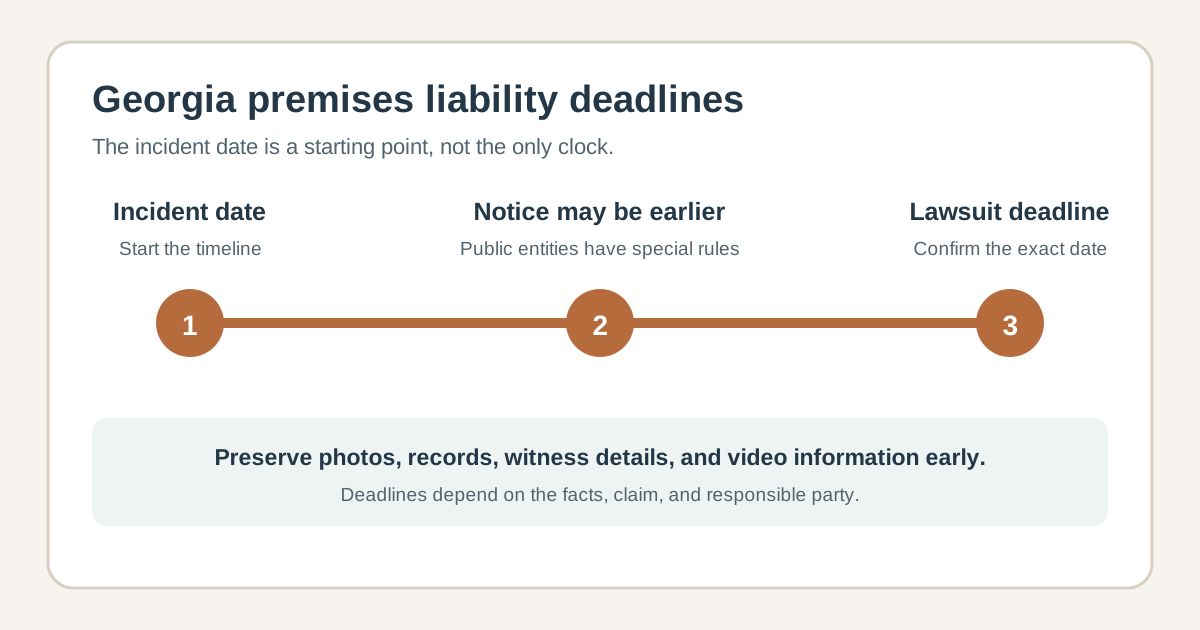
If you were hurt on someone else’s property, the georgia premises liability statute of limitations is usually two years for a personal-injury lawsuit. But that is not the only time limit that may matter: claims involving a city, county, or state agency can require written notice much sooner, and the right deadline depends on the facts and the proper defendant.
What is the Georgia premises liability statute of limitations?
In general, Georgia gives an injured person two years to bring a personal-injury action. The period is set out in O.C.G.A. § 9-3-33. A premises-liability case may involve a fall, an unsafe stairway, inadequate security, a falling object, or another dangerous condition. If the claim seeks compensation for bodily injury, the two-year period is an important starting point.
The deadline is not a promise that every claim has two years, and it is not a safe estimate of how long you can wait. Special rules may apply to claims against public entities, cases involving children or legal incapacity, and claims that include death or property damage. A different deadline may apply to a related claim based on a different legal theory. An attorney needs to identify who may be legally responsible and what claims the facts support before relying on a date.
The period generally runs from when the injury occurs, not when an investigation is finished, an insurance company makes a decision, or a person learns which legal theory might apply. In many cases, that means the incident date is the starting point. Complications can arise if an injury develops over time, if the injured person was a minor, or if a public entity may be responsible. Do not assume that a later diagnosis, continuing symptoms, or delayed discovery of a possible cause automatically moves the deadline.
There is also a difference between a lawsuit deadline and the work needed to prepare a sound claim. Waiting until the last weeks can make it harder to identify the right defendant, locate witnesses, inspect a hazard, obtain records, and complete any required notice. A person may have time left under the general statute but still face an urgent task under a separate notice rule.
Does the deadline change if the property belongs to the government?
It can. Claims against government entities often require a formal notice, sometimes called an ante litem notice, before a lawsuit may proceed. The notice period can be much shorter than two years. Which rule applies depends on whether the potential defendant is a city, county, state agency, or another public body, and on how the property and incident relate to that entity.
For a city, Georgia law generally requires written notice within six months of the event. Claims against a county generally have a 12-month notice requirement. A claim against the State of Georgia under the Georgia Tort Claims Act generally requires notice within 12 months. These are broad descriptions, not interchangeable rules or a complete legal test. The required recipient, contents, delivery method, and deadline can differ. Whether a particular public organization qualifies as a city, county, state agency, or separate authority may also require legal analysis.
For example, a fall at a municipal building may raise a claim against a city, while an injury at a county facility may implicate a county. A public university, transit operator, housing authority, or other public-facing organization should not be assumed to have the same status as a city or county. A private contractor may also have played a role. Identifying the owner, operator, maintenance company, and other potentially responsible parties is part of evaluating which deadlines and notice rules apply.
Sending a letter to the place where the injury occurred is not necessarily enough. Notice laws can specify who must receive notice and what information it must contain. Depending on the law, the notice may need to describe the time, place, circumstances, injury, and claimed loss. A form submitted to an insurer or an incident report handed to an employee should not be treated as a substitute for a legally sufficient notice unless an attorney has verified that it meets the applicable requirements.
Notice also does not automatically start a lawsuit or replace the lawsuit filing deadline. A claimant may have to meet both the notice requirement and the time limit for filing suit. A public entity’s investigation or response does not necessarily pause either clock. If government ownership or control is possible, seek legal advice promptly rather than waiting to resolve that question on your own.
How do you identify the correct deadline and defendant?
The person or business named in an incident report may not be the only party with responsibility for the property. Ownership, possession, control, maintenance, security, and responsibility for a particular area can be divided among multiple parties. A lease, management agreement, maintenance contract, or public-private arrangement may help explain who controlled the hazard. The legal identity of a defendant matters because it can affect both the claim and the deadline.
Start with the exact location and the entity that owned or operated it on the date of the injury. A property may have a trade name that differs from the legal business name. A building may be owned by one company, managed by another, and maintained by a contractor. A public facility may be operated by a separate authority rather than the government body most visible to visitors. These distinctions are not just paperwork; they can determine whom to notify and whom to sue.
Useful records may include a lease or rental agreement, receipt, parking record, event ticket, property-management contact, business registration, incident report, or correspondence with the owner. Do not trespass or confront anyone to obtain records. Save what you already have and give it to counsel. An attorney can investigate ownership and control through appropriate requests and records.
Bayuk Pratt’s Atlanta premises-liability practice page describes the firm’s work on claims involving unsafe property. The applicable statute and notice rule still depend on the incident, the parties, and the facts of the case.
How does the Georgia premises liability statute of limitations interact with the incident date?
For many injury claims, the period begins on the date the injury is sustained. In a typical slip-and-fall, that is usually the date of the fall. The fact that a person later discovers the full extent of an injury does not necessarily mean the legal clock begins on the date of diagnosis. Pain that worsens, a later procedure, or a new medical opinion may affect damages and proof, but does not automatically create a new limitations period.
Some incidents do not fit the simple example. A person may be exposed to a harmful condition over time, experience an injury that is not immediately apparent, or have multiple incidents. The correct accrual date can be a legal question. The fact that a claimant did not yet know who caused the injury also does not necessarily delay the start. Because Georgia deadlines can be strict, get case-specific advice when the date is uncertain rather than choosing the latest possible date.
Keep a written chronology. Record the date and approximate time of the event, when symptoms began, when medical care was sought, when a provider described the injury, and when you reported the incident. Note any later event that changed your understanding of what happened. This timeline does not decide the legal deadline by itself, but it helps a lawyer assess the facts and identify questions that need investigation.
Do not calculate a filing deadline by adding two years and assuming that a weekend, holiday, ongoing settlement discussion, or a pending insurance review will extend it. Time computation can depend on applicable rules, and a lawsuit generally must be properly filed in the correct court. Filing and serving a defendant are separate procedural steps. A lawyer can verify the actual due date and the steps necessary to preserve a claim.
What if the injured person is a child or cannot manage legal affairs?
Georgia law contains tolling provisions that may affect limitations periods for minors and some people who are legally incapacitated. Tolling means a deadline may be paused or adjusted under specified circumstances. These rules are technical and can have exceptions. A parent or guardian should not assume that a child has an unlimited period to bring a claim, especially if a government entity, medical provider, or other special defendant may be involved.
A child’s injury can also involve claims belonging to different people. The child may have a personal-injury claim, while a parent may have a separate claim for certain expenses. The deadlines for those claims may not be identical. Similarly, an adult’s serious injury, brain injury, or inability to communicate does not automatically mean every deadline is suspended. The legal standard for incapacity and the facts needed to establish it matter.
If the injured person is a minor, has a guardian, or cannot make legal decisions, contact an attorney promptly and explain those circumstances. Bring any guardianship or conservatorship documents and the incident and treatment dates if available. Do not wait for the person to turn 18 or regain capacity before asking whether a claim needs action.
What if the premises incident caused a death?
A fatal premises incident can give rise to wrongful-death claims and, in some cases, claims related to the person’s injuries before death. Those claims have their own legal rules. The date of death, the date of injury, the identity of the person entitled to bring a claim, and any government defendant may all matter. A family should not assume that the ordinary two-year personal-injury period answers every deadline question.
Georgia wrongful-death cases can also involve issues about who may pursue the claim and how a related estate claim should be handled. Those issues are especially important where the deceased person had a spouse, children, or other close family, or when more than one possible representative is involved. Preserve the relevant records and ask counsel to analyze all potential claims together.
For background on how time limits affect other Georgia injury cases, see Bayuk Pratt’s article on Georgia’s personal-injury statute of limitations. A general article cannot determine which deadlines apply to a particular death or premises case.
Are there other time limits besides the statute of limitations?
Yes. A statute of limitations is the period for bringing a lawsuit. Other procedural requirements can call for action earlier. A public-entity notice requirement is one example. An insurance policy may require prompt reporting, and a lease, event contract, or other agreement may contain notice provisions. These contractual or policy terms do not necessarily replace the statutory deadline, but ignoring them may create separate problems.
There may also be time-sensitive evidence. A business can routinely overwrite security footage, discard maintenance logs, or change a hazardous condition. Witnesses move or forget details. A damaged stair tread may be repaired before anyone photographs it. These are practical risks, not alternate statutes of limitations, but they can affect whether important facts remain available.
Making an incident report can help document that an event occurred, but it does not necessarily preserve a legal claim. An insurer’s acknowledgment, a claim number, or a promise to investigate does not necessarily extend a filing deadline. Do not rely on a claim representative to calculate your court deadline or advise you about the legal effect of an agreement. Ask an attorney to check the statute, notice rules, policy terms, and any written communications.
What should you do now to protect information about the incident?
After immediate medical needs are addressed, take reasonable steps to preserve information. You do not need to conduct a full investigation or risk your health. Write down what you remember while it is fresh, keep copies of records, and avoid altering original photos or messages. If an attorney becomes involved, provide the original files when possible and explain how and when they were created.
- Record the details. Note the date, time, address, exact area, lighting, weather, surface condition, warnings or barriers, and what happened immediately before and after the injury.
- Photograph what you can safely see. Capture the hazard and surrounding area from several angles. Include a wider view that shows location and context, as well as close views of the condition. Do not return to an unsafe area or enter private property without permission.
- Keep names and contact details. Save the names of witnesses, employees, managers, first responders, and anyone who helped. Ask witnesses for contact information without pressuring them to adopt a particular version of events.
- Save communications. Keep incident-report copies, emails, texts, letters, insurance information, and any responses from the property owner or public entity. Save envelopes and note dates of calls.
- Preserve medical information. Keep discharge instructions, visit summaries, referral details, bills, and records of missed work or daily limitations. Follow medical advice and tell providers about symptoms and how they affect you.
- Keep proof of expenses and losses. Save receipts and records related to treatment, transportation, caregiving, and time away from work. These materials may be relevant to a claim, though they do not determine liability or guarantee recovery.
Security video is often especially time-sensitive. If you believe a camera captured the event, write down where the cameras were and who controls them. A lawyer may send a preservation request to the appropriate party. A request does not guarantee that footage exists or that it will be produced, but acting early can reduce the risk that potentially relevant material is lost through routine deletion.
Be cautious about public posts and recorded statements. Do not speculate online about fault or the cause of an injury. If an insurer or property representative asks for a recorded statement or broad authorization, you can ask what it is for and seek legal advice before agreeing. Do not conceal facts or destroy materials. Be accurate in any report or communication.
Does contacting an insurance company stop the clock?
Usually, no. Reporting an injury to the property owner or its insurer is not the same as filing a lawsuit. Negotiations may take weeks or months, but they do not automatically pause a statute of limitations. An insurer may request records, investigate, or discuss settlement while the filing deadline continues to approach.
Do not wait for an offer before asking a lawyer to calculate the relevant deadlines. A settlement agreement can affect legal rights, and a signed release may end a claim. Before signing, make sure you understand which claims and parties it covers, what amount is being paid, and what rights you give up. A verbal statement that a claim is being reviewed is not a substitute for a written extension that an attorney has confirmed is valid.
If you already have an attorney, promptly share any new letter, offer, request, or proposed release. If you do not, consider speaking with counsel well before a deadline is close. A lawyer can review the facts, explain possible paths, and assess whether a lawsuit or formal notice may be necessary. For information about the firm’s approach, visit the Bayuk Pratt firm overview.
What happens if a deadline is missed?
If a claim is filed after the applicable limitations period, the defendant may ask the court to dismiss it as untimely. A missed ante litem notice requirement can also prevent a claim against a government entity from proceeding. The consequences depend on the specific rule and facts, but a late filing can seriously limit the ability to seek compensation through a lawsuit.
That does not mean a person should decide on their own that a case is over because time has passed. Questions about the correct accrual date, the identity of a defendant, tolling, notice, and the type of claim may require legal analysis. If you are close to a deadline or think it may have passed, speak with a lawyer immediately. Do not delay in order to gather every document first; explain what you know and what is missing.
Likewise, having time left does not mean the case is automatically viable. A premises claim may require evidence that the responsible party had the legally relevant knowledge of a hazard, failed to use reasonable care, and caused an injury. The details differ by case. A deadline preserves an opportunity to bring a claim; it does not establish fault or dictate the outcome.
How can a lawyer help assess the deadline?
An attorney can start by gathering the basic timeline and identifying possible parties. That may involve checking property ownership and control, reviewing incident reports and medical records, asking whether a public entity was involved, and determining which limitations and notice rules could apply. If more than one claim exists, each may need its own deadline review.
Legal counsel can also evaluate how to preserve evidence and communicate with the responsible parties. In a complex premises incident, the relevant proof may be held by a landlord, property manager, security company, maintenance contractor, business, or government agency. The evidence may include inspection and repair records, policies, photographs, video, contracts, and witness accounts. Obtaining and analyzing that material can take time.
Bayuk Pratt is an Atlanta personal-injury and civil-litigation firm representing individuals and families. The firm’s attorneys bring former senior-level corporate defense experience to their plaintiff-side work and prepare cases with trial in mind. The firm handles cases on a contingency-fee basis: clients pay nothing for the firm’s services unless it recovers compensation, with no upfront payment required. A free consultation can help you discuss the facts and ask what deadlines may apply. A consultation does not guarantee that the firm will accept a case or that any particular result will follow.
Talk with Bayuk Pratt about your situation
How do the possible deadlines fit together?
Think of a premises incident as creating a set of different clocks, not one universal countdown. The ordinary personal-injury statute may set the deadline to sue. A public-entity ante litem rule may require notice first. A policy or contract may call for earlier reporting. Evidence may disappear on an even shorter timetable. Each clock has a different purpose, and meeting one does not necessarily satisfy the others.
For example, imagine that an injury happens at a privately operated store. The injured person may need to investigate the store’s legal identity, who controlled the aisle, and whether another company maintained the floor. The usual two-year personal-injury period may be central, but medical treatment, evidence collection, and insurance communications will have their own timing. If the same kind of fall happens on a city-owned walkway, a shorter written notice rule could become critical even though the underlying injury claim is still subject to a separate lawsuit deadline.
Now consider an incident at a facility with a public name but unclear ownership. A sign bearing a city logo may not tell you which entity owns, operates, or maintains the area. A private management company might run the site, or a separate authority might control part of it. Do not choose a deadline based only on the sign or the employee who completed an incident form. Have the legal entities and relationships checked promptly.
These examples are illustrations, not conclusions about any actual claim. Small differences in where the hazard was located, who knew about it, which entity maintained it, and how the injury occurred can change the analysis. A cautious approach is to identify the earliest plausible deadline, then have counsel verify whether it applies. That is safer than assuming the longest possible period governs.
What common mistakes can put a claim at risk?
- Waiting for treatment to end. Some injuries need ongoing care, but waiting for a final medical outcome can leave little time to investigate or take required legal steps. Medical treatment and deadline review can happen at the same time.
- Assuming a property owner will keep the evidence. Video may be overwritten, repairs may be made, and ordinary business records may be discarded under routine retention practices. Identify likely evidence early and ask counsel about appropriate preservation steps.
- Using the wrong date. People may remember when they reported an injury or received a diagnosis but overlook the date of the event. Make a chronology and keep any messages, photographs, or receipts that help confirm the timing.
- Assuming the public entity is obvious. A government building, road, sidewalk, park, or transit location can involve more than one public body or contractor. The right recipient for notice may not be the person who spoke with you at the site.
- Relying on an adjuster’s timeline. An insurer may discuss a claim without advising you about court deadlines. Ask your own lawyer to calculate dates and review any proposed extension or release.
- Waiting until a deadline is near to find counsel. Last-minute investigation can make it harder to confirm parties, gather records, prepare a notice, and file in the proper court. Early review gives more time to address uncertainty.
These are preventable process risks, not a checklist that guarantees a successful case. The best steps depend on safety, health, the type of property, the possible defendants, and the facts. If you have already waited, still ask for advice right away instead of assuming no options remain.
What information should you have ready for a first legal conversation?
You do not need a complete file or a fully proven claim before asking about a deadline. A concise set of facts can help an attorney identify urgent issues and explain what additional information may be useful. If a detail is unknown, say so rather than guessing. You can organize what you have in a few basic groups:
- Incident information: date, approximate time, exact location, a plain description of the event, the condition that may have caused it, and the names of people who saw what happened.
- Property information: the business or facility name, street address, suite or area, the name of an owner or manager if known, and whether you believe a city, county, state, or public authority may be involved.
- Injury information: the injuries noticed at the scene, when medical care began, providers seen, and whether the injured person is a child or has a guardian or other decision-maker.
- Reporting and insurance: any incident number, report, claim number, insurer contact, written notice, recorded-statement request, or settlement document, with dates whenever possible.
- Materials already saved: photographs, video, messages, receipts, treatment paperwork, witness contact details, and notes about any camera or warning sign near the location.
Do not postpone the conversation while trying to obtain records that may take weeks to arrive. Explain the deadline concern first, especially if the event happened months ago or involved a government property. An attorney can tell you which facts are urgent and how to request additional information through proper channels.
Can an attorney tell me the exact deadline during a consultation?
Sometimes an initial review can identify the likely deadline, but a reliable answer may require additional facts. The lawyer may need to verify the event date, the injured person’s age and circumstances, the legal identity of an owner or operator, the type of claim, or whether the property is controlled by a public entity. If the facts are incomplete, the attorney may explain what is known, what remains uncertain, and which possible deadline should be treated as urgent while those questions are investigated.
That is not the same as postponing action. When more than one deadline may apply, a lawyer may recommend preserving the claim based on the earliest plausible one while confirming the legal details. If notice is required, the form and recipient may matter as much as the date. If a lawsuit is required, the correct court and parties need attention. A quick initial conversation can help identify these priorities without claiming that every legal issue is already resolved.
Does having time to file mean the premises claim is strong?
No. The statute of limitations answers a timing question; it does not decide whether a property owner or another party is legally responsible. In a Georgia premises case, the facts about the injured person’s status on the property, the condition that caused the injury, the responsible party’s knowledge, the steps taken to address the condition, and the cause of the injury may all matter. Those questions are separate from whether a lawsuit was filed on time.
For example, photographs of a spill may show that a condition existed when the picture was taken, but they may not reveal how long it had been there or who knew about it. A warning sign, inspection record, cleaning log, prior complaint, witness account, or video may add context. The absence of one type of record does not necessarily resolve the issue either. Evidence needs to be reviewed as a whole and connected to the legal questions in the case.
There may also be disputes about how the event happened or whether another cause contributed. Medical records can help document an injury and treatment, while scene evidence and witness accounts can provide information about the incident itself. A lawyer may compare those sources and investigate inconsistencies. No single document guarantees that liability will be established.
This is one reason to preserve facts before a property is repaired or records are lost. A prompt investigation can help determine whether a case is worth pursuing, while a deadline review ensures that the opportunity to seek that answer is not lost through delay. The two tasks support each other, but neither replaces the other.
What might a practical first-month plan look like?
The right sequence depends on the injury and the possible defendant, but a simple plan can help a person avoid letting a deadline question drift. This is not a requirement to do every item within a month or a substitute for legal advice. It is a way to keep health, documentation, and legal timing in view together:
- Address health and safety first. Obtain appropriate care, follow medical instructions, and do not return to a hazardous place to collect evidence. Tell a provider when and how the injury occurred so the medical record is accurate.
- Make a basic record of the event. Write down what happened, the precise location, the date, people present, and the condition you observed. Save original photographs and any messages or incident paperwork.
- Flag any public-property possibility. If a government body, public authority, school, transit system, or public facility may be involved, tell counsel at the outset. Do not wait for a final answer about ownership before raising the possibility.
- Get the deadlines checked early. Ask an attorney to identify the relevant claim types, potential defendants, court-filing period, and any notice requirement. If the event was not recent, make the date the first issue discussed.
- Preserve available evidence. Keep communications and records, note potential cameras and witnesses, and ask a lawyer about requesting preservation of material controlled by someone else.
- Review communications before signing. Keep copies of insurer and property-owner correspondence. Seek legal advice before providing a broad recorded statement, signing a release, or accepting terms that may resolve the claim.
There is no need to wait until every medical appointment is finished or every document has been gathered to ask about timing. If the claim is not viable, a prompt review can help explain why. If a claim may be viable, early identification of deadlines can leave more room to investigate responsibly.
How should you think about a deadline if months have already passed?
Act promptly, but do not assume the answer is obvious. The relevant date may depend on when the injury occurred and the type of claim. The appropriate defendant may not be clear from the start. A statutory notice may have a different deadline from a lawsuit. There may be facts about age, incapacity, death, or another issue that affect the analysis. Only a review of the specific circumstances can sort those issues out.
When you contact a lawyer, state the incident date as accurately as you can and mention any uncertainty. Say whether you have notified a city, county, agency, property owner, or insurer, and provide copies of whatever was sent. If you do not know the exact date, give the narrowest honest range you can and explain what records might establish it. Do not alter a document or guess to make the chronology seem more complete.
If a deadline may be close, do not spend days trying to build a perfect file before reaching out. A lawyer can tell you which missing information is essential and what can be investigated in parallel. If a period may have passed, counsel can assess whether any legal exception or distinct claim deserves review. Neither a late inquiry nor an uncertain date automatically determines the result, but further delay can make the questions harder to answer.
Frequently asked questions
Is every Georgia premises-liability case subject to a two-year deadline?
No. Two years is the usual starting point for a personal-injury claim, but government notice rules and special circumstances can require earlier action or affect the calculation. A wrongful-death claim, a child’s claim, or a case involving a public authority may raise separate questions. Have a lawyer identify the defendant and claims before relying on the general period.
Does the deadline begin when I learn how badly I am hurt?
Not necessarily. For many injury claims, the period generally starts when the injury occurs, rather than when its full extent becomes clear. Later diagnosis or worsening symptoms do not automatically restart the clock. If the injury developed over time or the incident date is disputed, obtain advice about how the rule applies to those facts.
How soon must I notify a city, county, or state agency?
As a broad guide, a city claim generally requires written notice within six months, while county and State of Georgia claims generally have 12-month notice periods. The entity’s legal status and the exact notice rules matter, including where and how to send the notice and what it must say. These deadlines are distinct from the time to file suit, so confirm both promptly.
Will an incident report or insurance claim preserve my right to sue?
Not by itself in every case. An incident report documents information, and an insurance claim may start an investigation, but neither should be assumed to meet a statutory notice rule or extend the court deadline. Ask an attorney to review what was sent, to whom, and when.
What if I do not know who owns the property?
Save the exact address, business or facility name, photographs, receipts, and any incident paperwork. Ownership, management, maintenance, and control may belong to different parties, and public facilities may involve separate authorities or contractors. An attorney can investigate the potentially responsible entities and assess which deadlines apply.
What is the safest next step?
Do not treat two years as a reason to wait. Write down the incident date, preserve the information you already have, and promptly ask a Georgia attorney to check the deadline, any government notice requirement, and the proper parties. This article provides general information, not legal advice; a lawyer must review the specific facts to assess your situation.