
Families asking how to prove medical malpractice in Georgia usually need more than a bad outcome. A poor result, by itself, does not show that a physician, nurse, hospital, or other provider departed from accepted care. Proof has to connect a specific act or omission to a specific injury. Georgia law expects a qualified medical expert to explain that connection. The practical work starts with the chart, the timing, and the harm you can document.
Request a free consultation to review the records before a deadline passes. You pay nothing unless the firm recovers compensation.
This guide explains the evidence Georgia cases actually use. It covers the four proof points, the records worth requesting, and the expert affidavit filed with a complaint. It also covers the higher proof used in some emergency care. It is general information, not a prediction about any claim. A lawyer has to apply the current statute to the dates and facts in the chart.
What does it take to prove medical malpractice in Georgia?
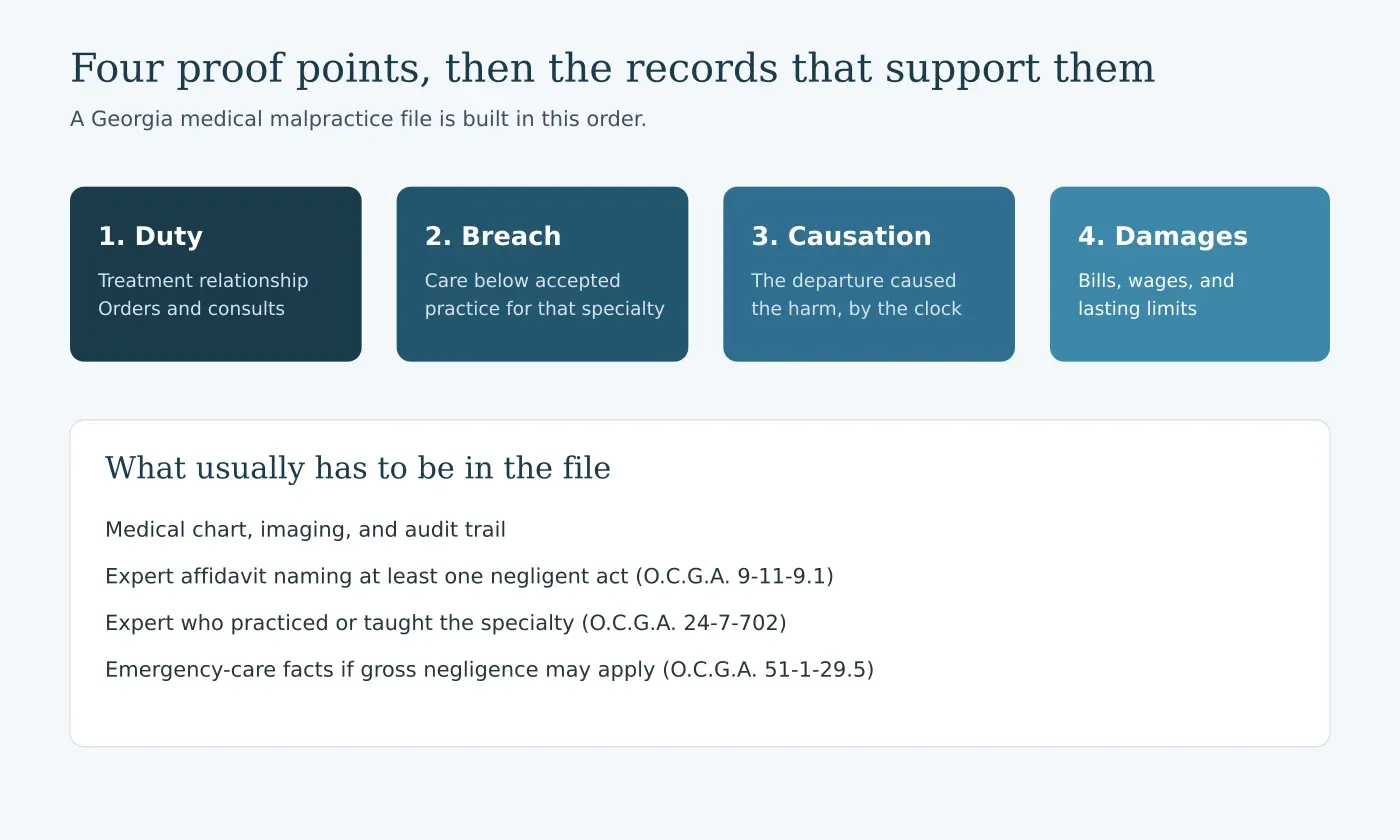
Georgia malpractice cases are built around four points. First, a provider-patient relationship created a duty of care. Second, the care fell below what a reasonably careful provider in that specialty would have done under similar circumstances. Third, that departure caused the injury. Fourth, the injury produced harm the law can recognize, such as added treatment, lost income, or lasting disability.
A complication listed on a consent form is not the same thing as a breach. Consent explains risks that can occur with proper care. Breach is a failure to meet the professional standard. That standard is usually explained by someone who practices or teaches the same kind of medicine. The Georgia medical malpractice practice page covers who may be responsible and what a claim can include. This article stays on the proof itself.
Keep these points in view while you gather papers:
- Duty comes from the treatment relationship, not from a casual conversation in a hallway.
- Breach is measured against accepted practice for that procedure or diagnosis, not against a perfect result.
- Causation asks whether the departure caused the harm, rather than the underlying illness.
- Damages are the concrete losses that followed, including treatment, work, and lasting limits.
Which records show how to prove medical malpractice in Georgia?
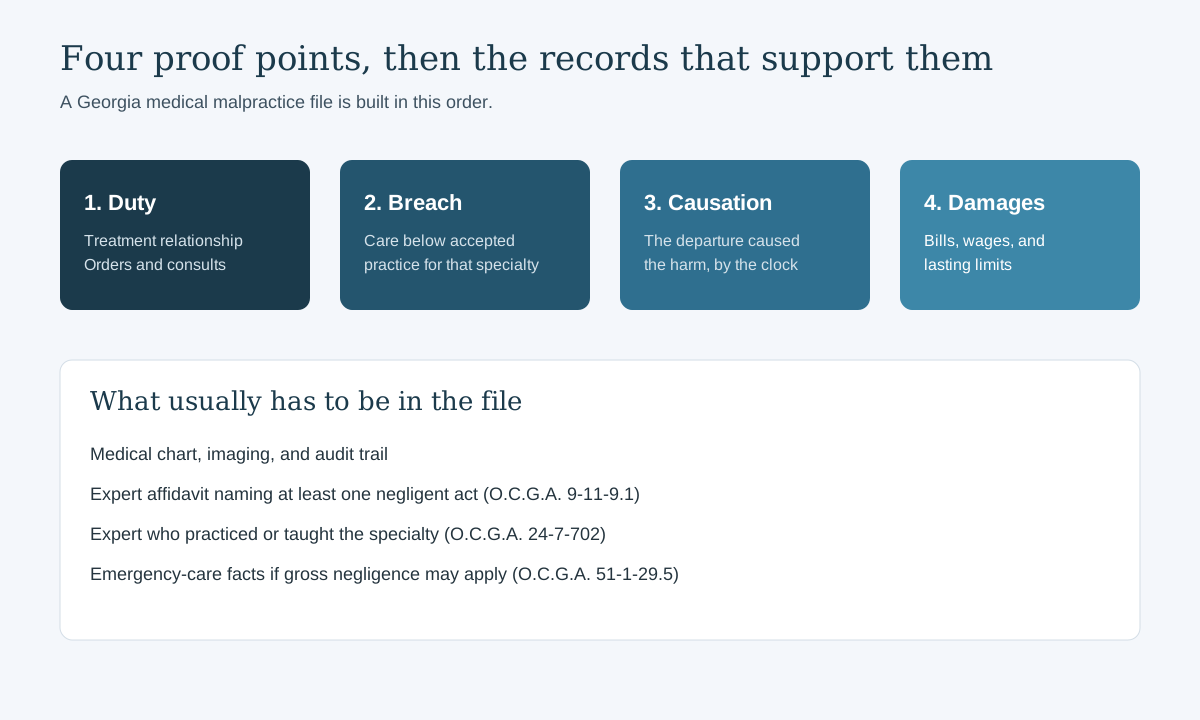
The chart is the backbone of the proof. A complete set is usually larger than the after-visit summary a patient portal shows. Useful records include admission and discharge notes, physician orders, and nursing notes. They also include medication records, operative and anesthesia reports, pathology, imaging, and lab trends. Add consent forms and the audit trail that shows when entries were made or changed.
Ask for records from every facility that treated the condition, not only the provider you believe made the mistake. A later hospital note can show when the injury became apparent. An earlier primary-care note can show what the first provider was told. If a transfer happened, the sending and receiving charts often disagree on timing, and that disagreement can matter.
Request records in writing and keep a copy of the request. Georgia patients have a right to their medical information, but facilities set their own forms, fees, and processing times. Do not rely on a partial download if the portal says older notes are unavailable. Billing records, itemized statements, and insurance explanations of benefits are separate from the clinical chart, and they help show what treatment followed the injury.
While you wait, write a dated timeline in your own words. Include symptoms, who you told, what you were advised, and when the condition changed. Memory fades, and a contemporaneous note is more useful than a reconstruction made months later. Save texts, portal messages, and photographs of wounds, devices, or discharge instructions.
How does an expert affidavit prove medical malpractice in Georgia?
Georgia generally requires an expert affidavit with a professional-malpractice complaint. Under O.C.G.A. § 9-11-9.1, the affidavit must set forth at least one negligent act or omission. It must also state the factual basis for that claim. The expert must be competent to testify. Filing the lawsuit without that affidavit can end the case, subject to a narrow timing exception.
That exception is not a planning tool. It applies when the limitation period will expire within ten days. The lawyer must also swear the firm was not retained more than 90 days before that period expired. The statute then allows 45 days after filing to supply the affidavit. The court is not to extend that time without every party’s consent. Missing the affidavit window can lead to dismissal for failure to state a claim. See the current text of O.C.G.A. § 9-11-9.1 on the Georgia General Assembly code site.
The affidavit is an early pleading requirement. It is not the full trial proof. Later testimony still has to satisfy the evidence rules, and the defense will test both the expert’s qualifications and the facts the opinion relies on. Sending a complete chart early gives the reviewer a fair basis for that opinion. A thin packet can produce a thin affidavit.
Who is allowed to give the medical opinion?
O.C.G.A. § 24-7-702 limits which opinions a jury may hear in a malpractice case. At the time of the alleged act, the expert generally must have been licensed in the state where the expert was practicing or teaching. In a medical case, the expert also needs actual knowledge of the specialty at issue. That knowledge must come from active practice, or from faculty teaching, for at least three of the last five years. The judge decides whether that experience was frequent enough to show real knowledge of the procedure, diagnosis, or treatment in dispute.
The same statute also addresses whether the expert must be a member of the same profession. A medical doctor and a doctor of osteopathy are not automatically interchangeable, and the details belong in the current code rather than in a shortcut. The practical point for a family is simpler. The reviewer should be someone who actually does, or teaches, the care being criticized. A specialist in a neighboring field may not be enough if that person does not perform the procedure.
You can read the qualification rules in O.C.G.A. § 24-7-702 on the Georgia General Assembly code site. Choosing the wrong expert is a proof problem, not a paperwork detail. If the opinion never reaches the jury, the records and the timeline cannot carry the standard of care by themselves.
How do you separate the injury from the illness?
Causation is where many otherwise concerning charts fall short. The question is not whether the patient got worse. The question is whether the provider’s departure from accepted care caused harm that would not otherwise have occurred, or made the harm materially worse. Causation can fail even when communication was poor. An already advanced cancer, a stroke already in progress, or a warned surgical risk can still occur with proper technique.
Useful proof compares the course that happened with the course a reasonable provider would have produced. Timing often supplies that causal link. A delayed lab, an unread imaging report, or a medication given despite a documented allergy can be tied to a later change. So can a failure to return to the operating room. The expert should be able to point to the note, the clock time, and the later injury. A general impression that something went wrong is not enough.
Alternative causes belong in the analysis before a complaint is filed. Prior disease, a patient’s inability to follow instructions, and a later provider’s care can all affect the story. Hiding those facts does not help. A defense expert will find them in the chart. An honest timeline lets your reviewer say which causes are plausible and which are not.
| Proof point | What it asks | Records that often matter |
|---|---|---|
| Duty | Was this provider treating the patient? | Admission orders, consult notes, on-call schedules |
| Breach | Did care fall below accepted practice? | Orders, nursing notes, policies, the expert affidavit |
| Causation | Did that departure cause the harm? | Timestamps, labs, imaging, transfer notes |
| Damages | What loss followed? | Bills, wage records, therapy notes, photographs |
| Emergency care | Does gross negligence apply? | Triage notes and proof the patient was not yet stable |
What changes when the care was an emergency?
Emergency care can raise the proof required. O.C.G.A. § 51-1-29.5 limits certain emergency-care claims to gross negligence. The statute also tells courts and juries which circumstances to consider. Emergency medical care, as defined there, is bona fide emergency service. It follows a condition with severe symptoms, when waiting could put health in serious jeopardy or cause serious impairment or organ dysfunction.
The definition does not cover care after the patient is stabilized and can be treated as a nonemergency patient. It also does not cover care unrelated to the original emergency. Stabilization is a fact question. A triage note can move a case from one standard to the other. So can a transfer to a floor bed, or an elective procedure the next day. Do not assume the higher standard applies to every hospital event, and do not assume it never applies because the visit began in a clinic.
The official text of O.C.G.A. § 51-1-29.5 is on the Georgia General Assembly code site. Gross negligence is a harder showing than ordinary negligence. The evidence still starts with the chart. What changes is the expert’s opinion about how far the care departed from accepted practice. Jury instructions may also change if the statute is triggered.
How should you document the harm?
Damages are proved with ordinary records, not with a round number. Itemized medical bills show the treatment that followed. Pay stubs, tax returns, and a letter from an employer show lost income. Therapy notes, home-care logs, and photographs show day-to-day limits. In a wrongful-death case, the estate and the surviving family may have different losses, and those should not be blended into one undocumented estimate.
A life-care plan is sometimes used when the injury requires future treatment. The Georgia life-care plan overview explains what that planning document covers. Wage proof has its own method, which is covered in how lost wages are calculated after a Georgia injury. Neither document replaces the medical opinion on causation.
Keep receipts even when insurance paid the bill. What a health plan paid, what was written off, and what is still owed can all become issues later. A folder with the explanation of benefits, the itemized bill, and the corresponding clinical note is more useful than a stack of summary statements.
Which deadlines can cut off the proof?
Evidence does not help if the case is filed too late. O.C.G.A. § 9-3-71 says a medical-malpractice action shall be brought within two years after the date the injury or death occurred. It also says that, notwithstanding that two-year limit, no action may be brought more than five years after the negligent or wrongful act or omission. The statute describes the two-year period as a statute of limitations and the five-year period as a statute of ultimate repose and abrogation.
Those periods are not identical, and they are not the only timing rules. O.C.G.A. § 9-3-72 uses a different clock when a foreign object is left in the body. The action shall be brought within one year after the object is discovered. The term foreign object does not include a chemical compound, fixation device, or prosthetic aid or device. Minors and people with certain legal disabilities are addressed in O.C.G.A. § 9-3-73, which the two-year and five-year provisions do not repeal. Confirm the section that fits the facts in O.C.G.A. § 9-3-71 and the neighboring sections on the Georgia General Assembly code site.
The date of the injury is not always the date of the surgery or the date a symptom was first noticed. That is why a lawyer should see the chart before anyone assumes time remains. Waiting for a complete prognosis can collide with the repose period even when the family only recently understood the cause.
What should you avoid while the records are gathered?
A few early choices make the later proof harder. These are warnings, not a complete checklist:
- Do not post a detailed medical story on social media. Photos and comments are commonly requested later, and a casual line can be read as a description of the injury.
- Do not sign a hospital release or a billing lien you do not understand. A release can give up claims. A lien can affect how any later recovery is divided.
- Do not give a recorded statement to a liability insurer before you have the chart. The statement becomes evidence, and it is given without the notes in front of you.
- Do not alter, annotate, or discard portal downloads. Keep the original file and put comments in a separate note.
- Do not assume a verbal apology is a complete admission. Concern after a bad outcome is not the same as proof of breach or causation.
It is reasonable to keep treating with the providers you trust. Continuing care can be part of reducing the harm, and gaps in treatment are often used to argue that the injury was minor. Tell each new provider about the earlier course so the new chart is accurate.
How does a law firm test the file before filing?
A careful review starts by putting the records in time order and identifying every provider who touched the decision in question. From there, counsel looks for the duty, the departure, the causal link, and the damages. The next question is whether an expert who meets O.C.G.A. § 24-7-702 can say so under oath. If the answer is no, the file should not be forced into a complaint just because the outcome was severe.
Bayuk Pratt represents people harmed by serious medical negligence and pairs that work with the founders’ background in defense-side litigation. The firm has assisted in recovering over $2 billion for clients since 2022. That history is not a promise about any new matter. The consultation is free, and the representation is on a contingency fee. There is no upfront payment and no attorney fee unless compensation is recovered.
Bring what you already have: portal downloads, discharge papers, bills, and the timeline. If you do not have the full chart, say so. Requesting it is part of the investigation, not a prerequisite for the first call. The broader sequence of an injury claim is outlined in the Georgia personal injury claims process. Malpractice proof is tighter because of the affidavit and the expert rules.
Speak with Bayuk Pratt about the records before a limitation or repose date removes the claim. Call (404) 500-2669. The firm is available 24/7, and the conversation can start with whatever papers you already have.
Frequently asked questions
Is a bad result enough to prove malpractice?
No. Georgia cases require proof that a provider’s care fell below accepted professional practice and that this departure caused harm. Medicine has known risks. An expert usually has to explain why this result reflects a breach rather than a risk of proper care.
Do I need every record before I call a lawyer?
No. A portal download, a discharge summary, and a short timeline are enough to start. The firm can request the complete chart, including imaging and the audit trail, if the initial papers justify a closer look.
What if the care happened in an emergency room?
Some emergency care is judged under a gross-negligence standard in O.C.G.A. § 51-1-29.5. Care after stabilization, or care unrelated to the emergency, may be different. The triage and transfer notes decide which standard is even arguable.
Can I file first and find an expert later?
Only in the narrow situation O.C.G.A. § 9-11-9.1 describes. The deadline must be about to expire, and the lawyer’s affidavit must meet the retention test. The extra time is 45 days, and it is not freely extended. It is safer to have the expert review underway before the deadline is close.
Will a consultation cost anything?
Bayuk Pratt offers a free consultation. If the firm takes the case, the fee is contingent on a recovery, with no upfront payment. A consultation is a review of the facts, not a promise of a result.
What is the next step?
Bring the chart, the timeline, and your questions to a free consultation. Bayuk Pratt can tell you whether the records support a closer expert review.