
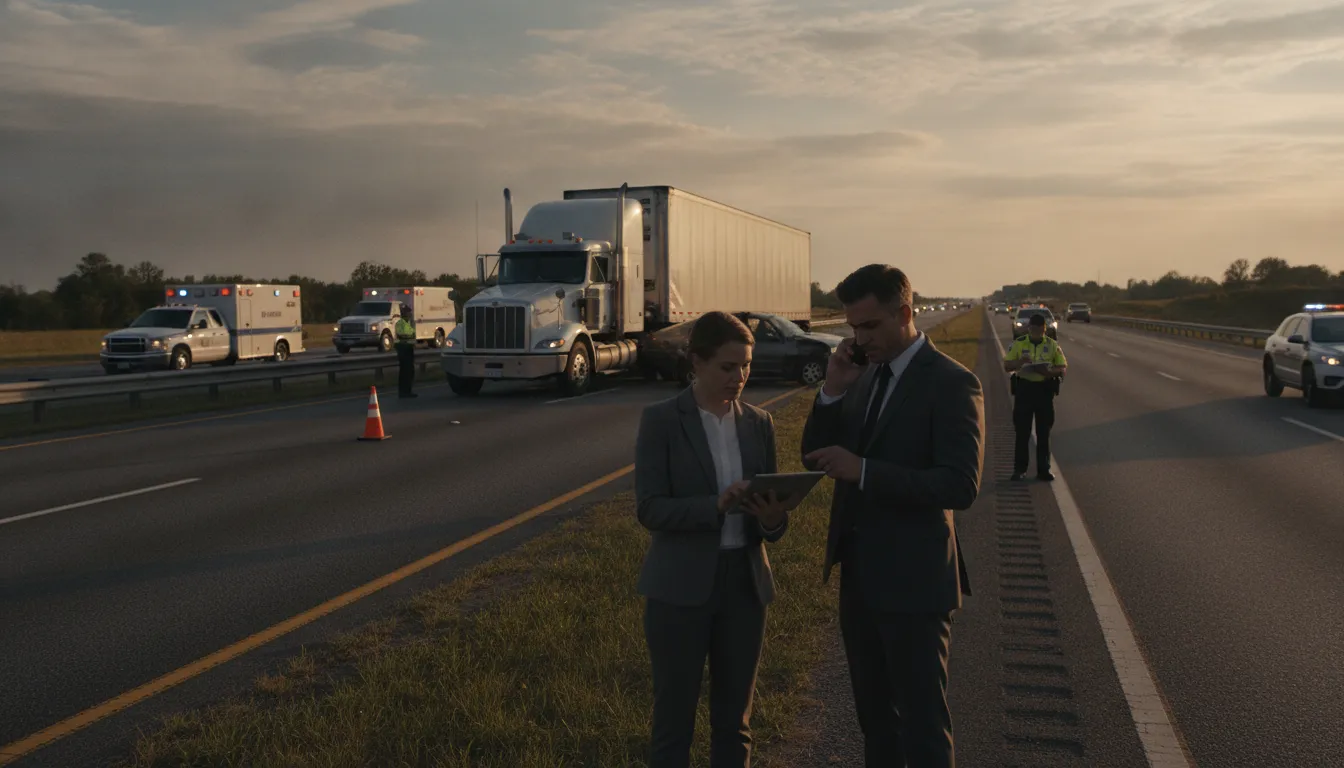
The force of a collision with a semi-truck can leave you feeling shaken and overwhelmed. In the chaos, it’s easy to forget that the evidence from the crash scene can disappear in a matter of hours. Your smartphone can be your most powerful tool in these initial moments. Taking the right photos, gathering specific information, and noting key details can make all the difference in your case. This guide explains exactly what to do after a semi truck accident to preserve the facts. Think of it as your personal investigation checklist to ensure the truth is documented before it’s too late.
Key Takeaways
- Protect Yourself at the Scene: Your first job is to get to safety and call for help. After that, use your phone to capture everything: damage to all vehicles, road conditions, and any logos or numbers on the truck. This initial evidence is incredibly powerful.
- Prioritize Your Health and Protect Your Words: Always get checked by a doctor after the crash, as adrenaline can hide serious injuries and medical records are essential for your claim. It’s just as important to protect your legal rights, so politely decline to give a recorded statement to the trucking company’s insurer.
- Hire a Specialist for a Complex Fight: A truck accident isn’t just a bigger car wreck; it involves complex federal laws and powerful insurance companies. Bringing in an experienced truck accident lawyer early on levels the playing field and lets you focus completely on your recovery.
What to Do Immediately After a Truck Accident
The moments after a collision with a large truck are chaotic and frightening. It’s easy to feel overwhelmed, but the steps you take right away are critical for your safety and for protecting your rights. Your first priority is always your well-being. Once you’re out of immediate danger, focus on gathering the information that will be essential for your case. Staying as calm as possible and following these steps can make a significant difference in the outcome of your situation.
Move to a safe location
Your safety is the top priority. If you can, turn on your hazard lights and move your vehicle to the shoulder or a nearby safe area, away from flowing traffic. If your car is too damaged to move, leave it where it is, but get yourself and any passengers out of the vehicle and to a safe distance from the road. The side of a highway is an incredibly dangerous place, so find a spot on a grassy median or well off the shoulder to wait for help to arrive. This simple action prevents further collisions and keeps everyone out of harm’s way.
Call 911 for help
As soon as you are in a safe spot, call 911. Do this even if the accident seems minor or if you think no one is seriously injured. When you call 911, you are requesting both police and emergency medical services. A police officer will create an official accident report, which is a vital piece of evidence that documents the scene, gathers initial statements, and provides an objective account of the incident. This report is often the first document your attorney will use to begin building your case and fight for you. Getting law enforcement involved ensures the accident is properly recorded from the very beginning.
Check on everyone involved
After calling for help, check yourself and your passengers for injuries. Adrenaline can mask pain, so be thorough. If you are able, you can also check on the driver and any passengers in the truck. However, keep your interaction brief and factual. Avoid getting into any arguments or discussions about what caused the crash. Your only goal here is to assess if anyone needs immediate medical assistance. Remember that some serious conditions, like internal bleeding or brain injuries, may not show symptoms right away. That’s why it’s so important for everyone to seek medical attention after the crash, regardless of how they feel.
Avoid saying you’re at fault
It might feel natural to apologize after an accident, but it’s crucial that you do not admit fault in any way. Simple phrases like “I’m so sorry” or “I didn’t see you” can be twisted by insurance companies and used to argue that you were responsible for the crash. Stick to the facts when speaking with the truck driver and even the police. You can express concern for others without taking the blame. Let the evidence speak for itself, and allow the investigators to determine what happened. Protecting your legal rights starts at the scene, and our battle-tested lawyers know exactly how to handle these communications to protect your interests.
How Truck Accidents Differ from Car Wrecks
A collision with a large commercial truck is not just a more severe version of a car wreck; it’s an entirely different kind of legal challenge. While any accident is stressful, truck accident claims involve complex federal laws, multiple responsible parties, and aggressive corporate insurance companies. Understanding these differences is the first step toward protecting your rights and getting the compensation you deserve for your injuries. These cases require a deeper level of investigation and a legal team prepared for a tougher fight.
Understanding federal trucking rules
Unlike the car you drive every day, commercial trucks are governed by a strict set of federal regulations designed to keep our roads safe. These rules cover everything from how many hours a driver can be on the road to mandatory vehicle maintenance schedules and cargo weight limits. When a trucking company or driver violates these rules, it can lead to devastating accidents. After a crash, trucking companies often send their own investigation teams to the scene immediately to collect evidence that protects their interests. This is why it’s so important to have an experienced attorney who can act just as quickly to preserve evidence and use these complex regulations to build a strong case for you.
Identifying all potentially liable parties
In a typical car accident, liability usually falls on one of the drivers. Truck accidents are rarely that simple. The fault could lie with several different people or companies, and a thorough investigation is needed to identify all of them. More than just the truck driver can be at fault. Other responsible parties may include the trucking company for negligent hiring or poor training, the maintenance crew for failing to service the vehicle properly, the cargo loaders for creating an unbalanced load, or even the manufacturer of a faulty truck part. An experienced lawyer will look into every possibility to ensure all responsible parties are held accountable for your injuries.
Dealing with large commercial insurance policies
Commercial trucks are required to carry insurance policies with much higher limits than standard passenger vehicles. While this might sound like good news, it doesn’t mean getting fair compensation is easy. In fact, it often means the opposite. With millions of dollars on the line, these large commercial insurers have teams of adjusters and lawyers who will fight hard to deny your claim or pay as little as possible. They are not on your side. You need a firm with a proven history of taking on these powerful companies and winning. Our team is proud of our case results and isn’t afraid to go to trial to get you the full amount you deserve.
How to Document the Accident Scene
The moments after a truck accident are chaotic and disorienting. If you are not seriously injured and can move around safely, one of the most powerful things you can do is document the scene. Evidence can disappear quickly. Vehicles get towed, skid marks fade, and memories get fuzzy. Taking a few minutes to gather information can protect your rights and become the foundation of a strong personal injury claim.
Think of yourself as an investigator preserving crucial facts. This evidence helps piece together exactly what happened and who is responsible. Insurance companies for the trucking line will have their own teams on the scene almost immediately, working to protect their interests. Documenting everything you can helps level the playing field. The information you collect can be critical for your attorney when they begin to build your case and fight for the compensation you deserve after a serious Atlanta truck accident. The following steps outline exactly what to focus on.
Take photos and videos
Your smartphone is your most important tool for evidence collection. Use it to take as many photos and videos as possible from different angles and distances. Capture wide shots of the entire scene to show the final resting positions of the vehicles. Then, get close-ups of the damage to your car, the truck, and any other property involved. Be sure to photograph the truck’s license plate, any company logos, and other identifying numbers on the vehicle. Document road conditions, traffic signals, skid marks, and debris on the road. If you have visible injuries, take pictures of those as well. You can never have too many photos, so capture anything that seems even remotely relevant.
Note the road and weather conditions
Details about the environment can play a significant role in your case. Was the sun in your eyes? Was the road wet from a recent rainstorm? Make a note of the weather conditions at the time of the crash. Also, look closely at the road itself. Document any important factors like nearby construction zones, potholes, unclear lane markings, or overgrown trees blocking a stop sign. These details might seem small, but they can help establish contributing factors to the accident. You can jot this information down in a notebook or even use the notes app on your phone while the details are still fresh in your mind.
Record the truck’s information
A commercial truck has more identifying information than a standard car, and it’s all important. Get the truck driver’s name, contact information, and their Commercial Driver’s License (CDL) number. Ask for the name of their employer and their insurance information. Look for a USDOT number displayed on the side of the truck cab or trailer. This number is issued by the Federal Motor Carrier Safety Administration and directly identifies the trucking company. Snap a picture of the DOT number, the license plate, and any other numbers you see on the truck. This information is essential for identifying all the parties who may be held liable for your injuries.
Look for nearby security cameras
Video footage can provide unbiased proof of how the accident happened. Take a moment to scan the area for any potential cameras that might have recorded the crash. Look for security cameras on nearby businesses, banks, or gas stations. Many traffic lights are also equipped with cameras, as are some private homes with doorbell systems. You don’t need to get the footage yourself, but make a note of the camera’s location. Write down the name and address of the business or the nearest cross-street. Your attorney can use this information to formally request the recordings, which can be invaluable evidence that supports your version of events and strengthens your case results.
What Information to Exchange After the Crash
In the chaotic moments after a crash, it’s hard to think clearly. But this is a critical time to gather information that will protect you later. Exchanging details with everyone involved is the first step in building your case and ensuring you can hold the right people accountable. Taking a few minutes to calmly get this information can make a significant difference in the outcome of your claim.
Get the truck driver’s details
The truck driver is a professional operator, so you need more than just their personal phone number. Get the driver’s full name, contact information, and Commercial Driver’s License (CDL) number. It’s also vital to get the name of the trucking company they work for, as the company is often a liable party in a truck accident claim. Ask for their insurance information, which will be for a commercial policy, and write down the truck’s license plate number and its USDOT number, usually displayed on the side of the cab. This information connects the driver to their employer and insurer, which is essential for pursuing compensation.
Collect witness contact information
What other people saw can be incredibly valuable. Independent witnesses have no stake in the outcome, so their accounts are often seen as highly credible. If anyone stopped to help or saw the collision happen, ask for their name and phone number. A neutral party who can confirm that the truck ran a red light or swerved into your lane provides a powerful, unbiased perspective that can strengthen your case. Politely ask if they are willing to wait and speak with the police, but getting their contact information is the most important thing in case they need to leave before the officers arrive.
Get the police officer’s information
When the police arrive, they will create an official accident report, which is a cornerstone of any injury claim. While the officer is conducting their investigation, make sure you get their name and badge number. You should also ask which precinct they are from and how you can get a copy of the police report once it’s filed. This report contains the officer’s observations, diagrams of the scene, and statements from everyone involved. Having the officer’s information makes it much easier to track down this vital document, which our team uses to establish the facts and support your claim. This evidence is what helps us achieve our proven results for clients.
Why You Need Medical Care, Even If You Feel Fine
After a truck accident, the rush of adrenaline can be a powerful painkiller. You might feel shaken but otherwise okay, and your first instinct might be to just go home and rest. Please don’t. Seeking immediate medical attention is one of the most important steps you can take, both for your health and for the strength of your potential legal claim. Many serious injuries don’t show symptoms right away, and what feels like minor soreness can be a sign of a much bigger problem.
Getting checked by a doctor creates an official record of any injuries you sustained in the crash. This documentation is critical. Without it, an insurance company can, and often will, argue that your injuries aren’t related to the accident or aren’t as severe as you claim. Your health should always be your top priority, but protecting your ability to get fair compensation is a close second. Let’s walk through exactly why a trip to the emergency room or an urgent care clinic is non-negotiable.
Watch for common hidden injuries
The force of a collision with a semi-truck is immense, and your body’s immediate response is to flood your system with adrenaline. This can effectively mask the pain of significant injuries. Symptoms of conditions like whiplash, concussions, or even internal bleeding may not appear for hours or even days. You might feel a little stiff or dizzy, but you could be dealing with a serious brain injury that requires immediate care. Soft tissue damage, which affects muscles and ligaments, is another common delayed-symptom injury. Only a medical professional can perform the necessary exams and imaging to rule out or diagnose these hidden conditions before they become more severe.
How medical records strengthen your claim
From a legal standpoint, your medical records are the foundation of your personal injury claim. They serve as undeniable proof that you were hurt and create a clear timeline linking your injuries directly to the accident. If you wait days or weeks to see a doctor, the trucking company’s insurer will likely argue that your injuries happened sometime after the crash or that they were from a pre-existing condition. This is a common tactic used to devalue or deny claims. By getting checked out right away, you create a powerful piece of evidence that we can use to fight for the full compensation you deserve.
The importance of following your treatment plan
Your medical journey doesn’t end after the initial diagnosis. Your doctor will create a treatment plan, which might include follow-up appointments, physical therapy, medication, or specialist visits. Following this plan is crucial. If you miss appointments or ignore your doctor’s advice, the insurance company can argue that you weren’t truly injured or that you weren’t taking your recovery seriously. This can significantly weaken your case. Sticking to your treatment plan shows that you are committed to getting better and provides ongoing documentation of your recovery process, which helps demonstrate the full impact the accident has had on your life and supports your claim for various types of damages.
How to Handle the Insurance Companies
After a truck accident, you will almost certainly have to deal with insurance companies. It’s important to remember that their primary goal is to protect their profits, not to ensure you get the compensation you deserve. Commercial trucking policies involve huge sums of money, and insurers employ experienced adjusters to minimize payouts. They might seem helpful, but every conversation is a calculated step in their strategy. Knowing how to approach these interactions is crucial for protecting your rights and the value of your claim. Here’s what you need to do.
Report the accident to your insurer
You do need to notify your own insurance company about the accident. Most policies require you to report a crash promptly. When you call, stick to the basic facts of what happened. Provide the details you collected at the scene, but avoid guessing or speculating about fault. It’s also wise to hold off on describing your injuries in detail, as many serious symptoms can take days or weeks to appear. Simply state that you are getting medical attention. While it’s your own insurer, remember they are still a business. Providing clear, factual information helps you meet your policy obligations without giving them anything that could be misinterpreted later.
Don’t speak to the other insurer alone
The trucking company’s insurance adjuster will likely contact you very quickly after the accident. It is critical that you do not speak with them or provide a recorded statement before you have consulted an attorney. These adjusters are highly trained to ask questions designed to get you to say something that harms your claim. They may ask you to admit partial fault, downplay your injuries, or agree to a version of events that isn’t accurate. Anything you say can be used against you. The best response is to politely decline to speak and refer them to your lawyer. This is where having battle-tested trial lawyers on your side becomes your shield.
Be wary of early settlement offers
It’s common for the trucking company’s insurer to present a quick settlement offer, sometimes within days of the crash. This might seem like a relief, but it’s a tactic to get you to close your claim for far less than it’s worth. At this early stage, you don’t know the full extent of your injuries, the cost of future medical care, or how much income you might lose. Insurers may even argue that your injuries were pre-existing or unrelated to the accident to justify a low offer. Accepting a quick settlement means you forfeit your right to any future compensation for this accident. Our firm’s case results show the difference that fighting for fair compensation can make.
Avoid These Common Mistakes That Can Weaken Your Claim
After a traumatic truck accident, it’s easy to say or do something that could unintentionally hurt your case. Insurance companies for the trucking firm are trained to look for any reason to pay you less than you deserve. Protecting your right to fair compensation starts with knowing what common pitfalls to avoid. Steering clear of these simple mistakes can make a significant difference in the strength of your personal injury claim.
Don’t admit fault
In the chaotic moments after a crash, it’s natural to want to be polite or express concern. You might be tempted to say “I’m so sorry,” but you should avoid apologizing or admitting fault to anyone. Even a simple apology can be twisted by an insurance adjuster and used as an admission of guilt to reduce their payout. Remember, you may not have all the facts about what caused the accident. Statements made at the scene can be used against you later. Stick to factual statements when speaking with the police and others at the scene. Let the investigation determine what happened. Your priority is your safety and well-being, not assigning blame.
Avoid giving a recorded statement
Soon after the accident, you will likely get a call from the trucking company’s insurance adjuster. They may sound friendly and say they just need a recorded statement to process your claim. You are not required to give them one. Politely decline and tell them your attorney will be in touch. The adjuster’s job is to protect their company’s bottom line, and they are skilled at asking questions designed to get you to downplay your injuries or say something that damages your claim. They might use your words against you. Always speak with a lawyer before ever agreeing to a recorded statement.
Be careful what you post on social media
Insurance companies will often investigate your social media profiles for anything they can use against you. Be cautious about what you post. A photo of you at a family barbecue or a comment about feeling a bit better could be taken out of context to argue your injuries aren’t as severe as you claim. The best course of action is to stop posting on social media altogether while your case is ongoing. You should also ask friends and family not to post photos of you or tag you in any posts. It’s a small sacrifice that can protect your claim from being unfairly devalued.
Don’t wait too long to take action
Time is not on your side after a truck accident. It’s critical to seek medical attention right away, even if you feel fine. Some serious injuries don’t show symptoms immediately. If too much time passes before you see a doctor, an insurer may argue your injuries are unrelated to the crash. It’s also important to act quickly to preserve evidence and protect your legal rights. Key evidence can disappear, witnesses’ memories can fade, and you must file a claim within Georgia’s statute of limitations. Taking prompt action is essential for building the strongest possible case and achieving the results you deserve.
Know Your Legal Rights After a Truck Accident
After a traumatic event like a truck accident, it’s easy to feel overwhelmed and unsure of what to do next. But it’s important to know that you have specific legal rights that protect you and your ability to recover. Understanding these rights is the first step toward ensuring you aren’t left with the financial burden of someone else’s negligence. From getting paid for your losses to making sure critical evidence is saved, here’s what you need to know about your rights.
Your right to fair compensation
If a truck driver’s or trucking company’s actions caused your injuries, you have the right to seek compensation for your damages. This isn’t just about covering your initial emergency room visit. Fair compensation should account for all of your losses, including ongoing medical treatments, physical therapy, lost income from being unable to work, and the pain and suffering you’ve endured. Truck accidents often cause serious injuries that require long-term care, and you shouldn’t have to pay for that out of your own pocket. An experienced attorney can help you calculate the full extent of your damages to ensure you demand what you are rightfully owed for your personal injury claim.
Your right to preserve evidence
In a commercial truck accident case, evidence is everything, and it can disappear fast. Trucking companies are only required to keep records like driver logs, inspection reports, and electronic data for a limited time. After that, they can legally destroy them. You have the right to preserve this evidence. Your attorney can send the trucking company a formal “preservation letter,” which legally obligates them to save all materials related to the crash. This is a critical step that our battle-tested trial lawyers take immediately to protect crucial information that could prove fault and strengthen your case. Acting quickly is key to preventing vital evidence from being lost forever.
Understand Georgia’s statute of limitations
In Georgia, you have a limited window of time to file a lawsuit for a personal injury claim. This deadline is called the statute of limitations, and for most cases, it is two years from the date of the accident. If you fail to file your claim within this two-year period, the court will likely refuse to hear your case, and you will lose your right to seek compensation permanently. While two years might sound like a long time, building a strong truck accident case involves a thorough investigation that shouldn’t be rushed. Contacting a lawyer early ensures all legal deadlines are met while you focus on your recovery, preserving your chance to achieve significant case results.
When Should You Hire a Truck Accident Attorney?
Deciding to hire an attorney can feel like a big step, but after a collision with a commercial truck, it’s one of the most important decisions you can make. These cases are far more complex than a typical car accident claim. The trucking industry is governed by a web of federal and state regulations, and there are often multiple parties who could be at fault. This could include the driver, the trucking company that employs them, a separate maintenance provider, or even the company that loaded the cargo. Untangling this web of responsibility is a job for a legal professional.
Insurance companies for commercial trucks are known for being aggressive. Their goal is to protect their bottom line by paying out as little as possible. They have teams of investigators and lawyers who start working immediately after a crash, often arriving at the scene to gather evidence that benefits their side. They might pressure you for a recorded statement or offer a quick, lowball settlement before you even know the full extent of your injuries. Having an experienced attorney on your side levels the playing field and ensures your rights are protected from day one. Your lawyer will manage the legal complexities so you can put all your energy into your recovery.
Signs it’s time to hire a lawyer
If you were injured in an accident with a large truck, the best time to think about hiring a lawyer is right away. These accidents are rarely simple. The injuries are often severe, leading to expensive medical bills and a long recovery period. Unlike a standard car wreck, a truck accident can involve multiple responsible parties. Figuring out who is at fault can get complicated quickly, and evidence can disappear. An attorney who specializes in truck accidents can protect your rights from the start and work to get you the fair compensation you need to cover your costs and move forward with your life.
How a truck accident lawyer can help
Hiring a lawyer takes the pressure off you so you can focus on healing. A truck accident attorney acts as your guide and advocate through the entire process. They start by investigating the crash to preserve critical evidence, like the truck’s black box data and driver logs, before it is lost. Your lawyer will also identify all the parties who could be held responsible for your injuries. Most importantly, they will handle all communications with the trucking company’s insurance adjusters. Our battle-tested lawyers understand your options and can build a strong case on your behalf, ensuring you are positioned to receive full compensation.
How Bayuk Pratt LLC can fight for you
When you’re dealing with serious injuries and financial stress after a truck accident, you need a team of competent and aggressive trial lawyers on your side. At Bayuk Pratt, we provide the expert legal guidance and dedicated support you deserve. We have a deep understanding of the laws that govern the trucking industry, and we know how to hold negligent companies accountable. Our firm has a long history of securing significant case results for people just like you. We prepare every case as if it’s going to trial, showing the insurance companies that we are serious about fighting for the maximum compensation you need to rebuild your life.
Frequently Asked Questions
I feel fine after the accident. Do I really need to see a doctor? Yes, absolutely. The adrenaline from a crash can hide serious injuries like concussions or internal damage that may not show symptoms for hours or even days. Getting a medical evaluation right away is crucial for your health. It also creates an official record that connects your injuries to the accident, which is a vital piece of evidence for your claim. Waiting to seek care gives the insurance company an opportunity to argue that your injuries are not related to the crash.
The trucking company’s insurance adjuster called and wants a statement. What should I do? You should politely decline to give any statement, especially a recorded one, before you have spoken with an attorney. These adjusters are trained to ask questions that can get you to unintentionally hurt your own claim. Your best response is to get their contact information and let them know your lawyer will be in touch. This protects you from saying something that could be taken out of context and used against you later.
I already said “I’m sorry” at the scene. Have I ruined my case? Not necessarily, so don’t panic. While it’s never ideal to apologize or admit any fault, a single comment doesn’t automatically destroy your case. Many factors determine liability in a truck accident. However, it does make the situation more complicated and gives the insurance company something to use against you. This is a perfect example of why it’s so important to contact an experienced attorney right away. They can help manage the situation and build a strong case based on the facts.
How long do I have to file a claim after a truck accident in Georgia? In Georgia, the statute of limitations for most personal injury cases is two years from the date of the accident. This is a strict deadline. If you try to file a lawsuit after this two-year window has closed, your case will almost certainly be dismissed. Building a strong truck accident claim takes time, so it is critical to act quickly to preserve evidence and ensure all legal deadlines are met.
I’m worried about the cost. How can I afford to hire an experienced truck accident lawyer? This is a very common concern, but most reputable personal injury firms, including ours, work on a contingency fee basis. This means you pay no upfront costs for our legal services. We cover all the expenses of building and litigating your case. We only get paid a percentage of the settlement or verdict if we win your case. If you don’t get compensation, you don’t owe us a fee. This allows you to get expert legal help without any financial risk.